
Being fired does not always mean your employer was legally entitled to fire you.
South Carolina is an at-will employment state, but that protection has limits when a termination is based on discrimination, retaliation, whistleblowing, a workers’ compensation claim, or another protected activity.
The difficult part is often figuring out what actually caused the termination. An employer may point to performance problems, restructuring, attendance, or another legitimate-sounding explanation. The timing, internal records, communications, and treatment of other employees may tell a different story.
If you are trying to understand whether your termination crossed that line, our Myrtle Beach wrongful termination attorneys can examine what happened and identify which legal protections may apply.
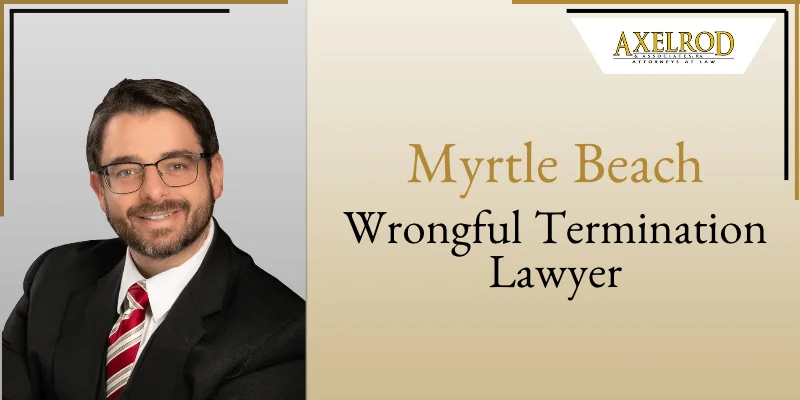
Stuart Axelrod has spent 27 years practicing in South Carolina courts and has tried more than 200 cases. Before representing clients against well-resourced opponents, he spent nearly a decade as a public defender in Horry and Georgetown Counties. That courtroom experience shapes how Axelrod & Associates approaches employment disputes, with an emphasis on evidence, preparation, and being willing to take a case to trial when necessary.
Protect your legal rights after an unexpected job loss. Reach out to Axelrod & Associates to provide the details of your firing, and let our attorneys help you understand your legal options and rights under South Carolina employment law.
If the matter is serious, your counsel should be exceptional.
Wrongful termination can take different forms, and the employer’s stated reason is not necessarily the end of the inquiry. The circumstances surrounding the decision may reveal whether an otherwise ordinary firing was connected to protected conduct or an unlawful motive.
Potential examples include:
The specific facts matter. A termination that feels unfair is not automatically unlawful, but an employer’s explanation does not automatically make the termination legal either.
A wrongful termination claim often turns on evidence that was created before anyone started talking about a lawsuit. The goal is to identify that evidence early and determine what it shows.
The first conversation should establish what happened before, during, and after the termination. What was your employer’s stated reason? Had your performance reviews changed? Did you make a complaint or request an accommodation shortly before the firing? Who knew about it?
A timeline can reveal inconsistencies that are difficult to see when the events are considered separately.
Personnel records, performance reviews, disciplinary notices, emails, text messages, complaints, and other employment documents can help establish what your employer knew and when it knew it.
A sudden change in your evaluations or disciplinary history may be significant, particularly when it occurs shortly before termination.
Not every wrongful termination claim follows the same procedure. Your case may involve the South Carolina Human Affairs Commission, the EEOC, a workers’ compensation retaliation claim, a public-policy claim, a contract claim, or another legal theory.
The applicable law also affects the deadline for taking action.
Coworkers may have information about what happened, what managers said, or how other employees were treated in similar circumstances. Evidence showing different treatment can become important when an employer claims that a termination was based on a legitimate business reason.
An employer’s handbook and internal procedures can provide another point of comparison. If the company normally follows a progressive discipline process but departed from that process in your case, the reason for that departure may warrant closer examination.
The objective is to build a case supported by documentation, witnesses, and a coherent timeline.
Some disputes can be resolved through negotiation or mediation. Others require litigation. The case should be prepared with the understanding that it may ultimately need to be presented to a judge or jury.
Once your employment ends, the clock may already be running on your legal rights.
Records can disappear. Coworkers may leave the company. Memories become less precise. And the longer an employer’s explanation goes unchallenged, the more difficult it may become to reconstruct what actually happened.
There can also be immediate financial consequences. Lost wages, the loss of health insurance, and the difficulty of finding comparable employment can put significant pressure on you and your family. In a close-knit employment market such as Myrtle Beach, concerns about how a termination may affect future opportunities can add another layer of uncertainty.
The evidence does not always come from one document or one conversation. It may be the combination of a changed performance review, the timing of a complaint, an email that contradicts the employer’s explanation, or evidence that another employee was treated differently.
That is why an early review matters.
For discrimination and retaliation claims covered by South Carolina’s Human Affairs Law, the source materials state that a charge generally must be filed with the South Carolina Human Affairs Commission within 180 days of the termination. That period may extend to 300 days when the charge is dual filed with the federal EEOC.
Other types of claims can have different deadlines, so the applicable deadline should be identified based on the specific claim.
Filing an employment claim is not the same as heading straight to trial.
For discrimination claims that proceed through the South Carolina Human Affairs Commission or the EEOC, the employer receives notice and an opportunity to respond. The agency may investigate the allegations before issuing a notice of right to sue.
A well-supported claim may also create an opportunity for negotiation or mediation. Once the employer has to confront the timeline, employment records, communications, and witness evidence, the dispute may look very different from the initial termination decision.
Not every case settles, and settlement is not appropriate in every situation.
When litigation becomes necessary, the evidence developed during the investigation can form the foundation of the case presented to a judge or jury.
For Myrtle Beach workers pursuing a state-law claim, the Court of Common Pleas at the Horry County Judicial Center in Conway serves as the civil court for the 15th Judicial Circuit.
A claim based on federal law, such as Title VII of the Civil Rights Act or the Americans with Disabilities Act, may instead proceed in federal court. The United States District Court for the District of South Carolina, Florence Division, covers Horry County along with neighboring counties.
Before filing in court, many employment discrimination claims must first proceed through the South Carolina Human Affairs Commission or the EEOC. The appropriate filing path depends on the type of claim, the employer involved, and the circumstances surrounding the termination.
Myrtle Beach’s tourism-driven economy also means many local workers are employed in seasonal, hourly, and hospitality positions. Those workplaces may rely more heavily on verbal instructions and informal disciplinary practices, which can make preserving available documentation especially important when an employment dispute arises.
South Carolina follows the at-will employment doctrine. An employer may terminate an employee without warning and without having to establish a good reason for doing so.
But there are important exceptions.
Under South Carolina Code Section 1-13-80, employment discrimination based on protected characteristics including race, color, religion, sex, age, national origin, and disability is prohibited.
South Carolina courts have also recognized claims based on violations of clear public policy, including certain circumstances involving employees who refuse to engage in unlawful conduct or report criminal activity.
The legal remedy depends on the claim. Potential remedies may include back pay, front pay, reinstatement, or other damages, depending on the applicable law and facts.
Because employment law can change through legislation and court decisions, the law applicable to a particular termination should be evaluated based on the circumstances and the date of the events involved.
Useful evidence may include performance reviews, disciplinary records, emails, text messages, employment policies, complaints, and witness statements. The important question is often whether the evidence supports your account of why the termination occurred.
South Carolina law provides protection against termination in retaliation for pursuing workers’ compensation benefits. An employer may still have a legitimate reason to terminate an employee that is unrelated to the workers’ compensation claim, so the circumstances surrounding the decision matter.
The South Carolina Human Affairs Commission handles state-level employment discrimination matters, while the EEOC enforces federal employment discrimination laws. The agencies have a work-sharing relationship, so an employee can file with one agency rather than submitting separate charges to both.
The answer depends on the language of the agreement, the circumstances surrounding the termination, and the specific rights the agreement attempts to waive. A signed severance agreement should be reviewed before assuming it prevents further action.
Seasonal and hospitality workers can have the same protections against unlawful discrimination and retaliation as other employees. The nature of seasonal employment may affect the evidence and damages in a particular case, but it does not automatically remove legal protections.
Yes, depending on why the termination occurred. An employer can make legitimate performance-based decisions, but a performance explanation does not protect a termination that was motivated by unlawful discrimination or retaliation. The timing, records, communications, and treatment of comparable employees can help distinguish between the two.
Most claims are resolved privately through negotiation or mediation, and a future employer has no automatic way to see that you filed a charge unless it becomes public through a lawsuit.
Yes, if the layoff was a cover for discrimination or retaliation. We look at who else was let go, how the decision was made, and whether the timing lines up with anything else going on in your situation.
No. You are not required to have new employment before pursuing a wrongful termination claim, though your damages calculation may account for how quickly you find comparable work afterward.
Wrongful termination cases depend on careful investigation, documentation, witness testimony, and preparation for litigation. Stuart Axelrod has spent 27 years handling cases in South Carolina courts and has tried more than 200 cases. That experience provides a courtroom-focused approach to evaluating employment disputes and preparing them for whatever resolution the circumstances require.
Losing a job can leave you dealing with immediate financial pressure while still trying to understand what happened. You may know the explanation your employer gave you, but not whether that explanation reflects the real reason for the decision.
That distinction can determine where your claim must be filed, which deadlines apply, and what procedural steps you must take.
Axelrod & Associates can review the circumstances surrounding your termination, examine the available evidence, and help determine whether the facts support a wrongful termination claim. If discrimination or retaliation is involved, the applicable filing deadline may be shorter than you expect, so getting the situation evaluated promptly can help preserve your options.
If your termination raises questions about discrimination, retaliation, or another violation of your rights, contact Axelrod & Associates. A review of your case can help determine whether you have a legal claim and what you can do about it.

I just had the most awesome results with Axelrod Law Firm, particularly with Tatiana Berkey! She got my 8 points reduced to zero with only a $25 fine! She was so informative, caring and productive! It’s a great law firm with great results!
The staff at Axelrod&Associates is far none the best on the grand strand.they have taken care of 5 different cases for me and they went way above my expectations. Heather,Kelly ,Stuart and notably the best paralegal in the business…”Jenna” are so professional and most of all….caring. A million thanks to everyone there.
Go see Kate O’Hara! Her and her team work great together! Kept me up date and answered all the questions that I had! I couldn’t thank them enough!
Words can’t describe how thankful I am for this law firm ! They went way beyond anything I could have ever expected. If you are looking for a firm that really cares about their clients , this is the one!
Great experience working with Jenna and Heather on my adoption. It has been a long, lengthy process, and they were great getting me through all of it. Would recommend and definitely use them again in the future if needed. Thank you so much.






The fields marked with * are mandatory.

Our attorneys handle a wide range of legal concerns ranging from personal injury, to traffic tickets to criminal charges to on-the-job injuries, to divorce and custody matters, to social security and veterans administration disability claims.
4701 Oleander Drive, Suite A
Myrtle Beach, SC 29577
843-484-3983
1550 N. Oak St.
Myrtle Beach, SC 29577
843-390-9090
1510 Ebenezer Road
Rock Hill, SC 29732
803-956-1224
3700 Golf Colony Ln
Little River, SC 29566
© Copyright 2026 Axelrod & Associates, P.A. • All Rights Reserved. Disclaimer | Site Map | Privacy Policy. Digital Marketing By: 
Images are obtained under license from Canva and other third-party stock image providers, with attribution included where required.
 Spanish